|
CD CAPABILITIES
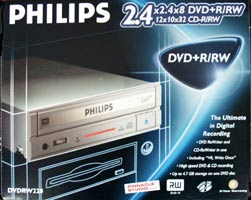
The Philips DVDRW228k supports 12
speed CD writing, 10 speed CD-Rewriting
and 32 speed CD-ROM reading - these
speeds are faster than any of the
rival DVD "-" (minus) writers
can achieve.
Firstly, we examined the speed at
which it can write to CDs using various
media. The media we tried were identified
as: Moser Baer India Ltd, Multi Media
Masters Machinery SA & Ritek Co.
CD-R Media Writing Test
First we checked the drives ability
to write to CD-R media at the full
x12 speed:
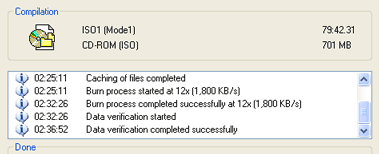
Using NERO it took 7mins and 15secs
to write a full 80mins of data to
a CD-R (40 x speed approved) disk
(this is excluding the verification
times).
CD-RW Media Writing Test
We tested the time it took to erase
a CD-Rewritable in FULL erase mode.
Nero showed the available speeds as
10x & 4x (depends on disk):
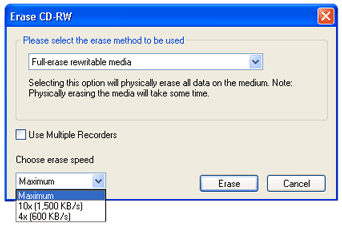
The drive took 9mins and 10seconds
to erase a CD-RW in FULL-erase mode.
DATA CD-RW
We timed a FULL data CD-RW disk:
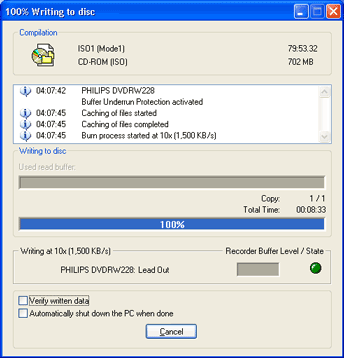
The writer took 8mins and 33 seconds
to write a full 80min CD.
PRESSED DATA CD READING
Reading a pressed CD should be an
easy task for any drive due to the
good reflectivity/quality of the disks:
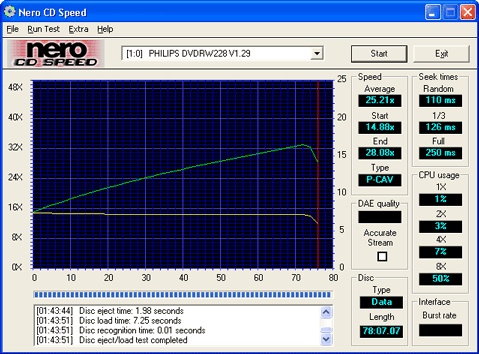
As you can see it managed an average
of 25.21 x speed using P-CAV. It did
a little better towards the end of
the disk (but it still fell short
of its rated 32x speed).
CD-R MEDIA DATA Reading
The speeds often achieved with pressed
CD-ROM media are not always mirrored
with CD-R media due to quality and
reflectivity issues (here we give
it a Mitsui branded data
CD-R):
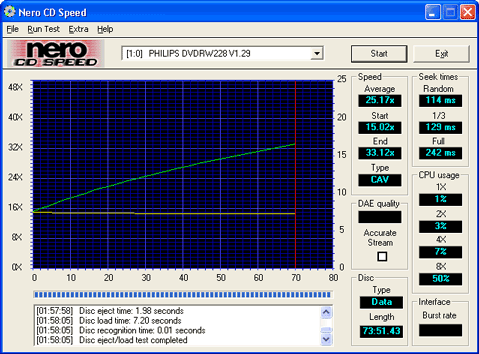
In this case its speed is virtually
the same as a pressed CD i.e. 25 x
speed.
CD Digital Audio Extraction
The drive was next tested for its
ability to extract audio from CDs
and its quality was reported below.
This test was done using the popular
program "CD Speed"
by Ahead.
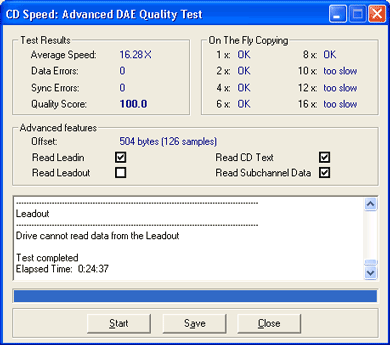
Although the drive
is not as fast as the Panasonic LFD-311
(in the CD Speed advanced
test) it did managed a good 16.5x
average audio ripping speed of the
test CD. As also shown in the screen
shot it can read CD-TEXT. It returned
0 data errors and sync errors with
a quality score of 100 which is a
near perfect result in this test.
The drive is only good as a reader
for another CD writer for 8 x speed
recording on the fly.
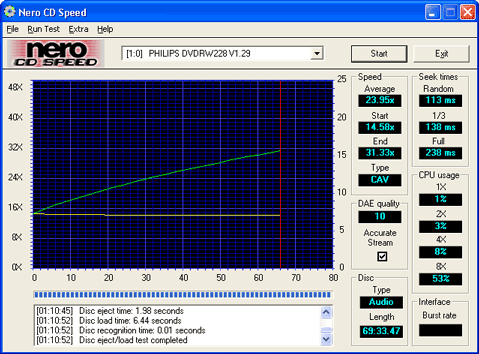
Again we tested the DAE, but instead
of using the tester CDR disk we used
a pressed audio CD. It gave a better
score averaging x 23.95 speed DAE
with perfect quality and an accurate
speed. What is strange is that at
8x reading the CPU usage went up to
50% (we suspect this is an error with
Nero CD Speed and not the
drive).
C2 Error Information
Next we examined the ability of the
Philips drive to accurately extract
audio information. This is aided by
something called C2 error information
which is on a CD. The following explains
what C2 error information is (from
Exact Audio Copy's web site):
What is C2 ?
Answer: On all CD-ROM media there
are at least two levels of error correction,
called C1 and C2. If both fail, the
output is probably not correct anymore.
Most drives are not able to report
if audio reads failed or not, so each
block has to be read twice and be
compared to make sure that everything
is fine.
Newer drives are able to report if
C1 / C2 failed on specific samples
on a read, making it possible to read
only once and see if a read error
occurred. But there is still a problem,
as some drives do not report these
errors correctly, so you should test
it thoroughly before trusting the
results.
In layman's terms if your drive can
report C2 information then it will
be faster and more accurate at ripping
audio.
 We
used Exact Audio Copy's "Detect
Read Features" option to examine
what the drive could do. The drive
does cache audio which is not ideal
as it can affect audio ripping. It
has an accurate stream and it can
report C2 error information from CDs,
which is good. We
used Exact Audio Copy's "Detect
Read Features" option to examine
what the drive could do. The drive
does cache audio which is not ideal
as it can affect audio ripping. It
has an accurate stream and it can
report C2 error information from CDs,
which is good.
  Page
3 - Last Updated: 25 July 2002 Page
3 - Last Updated: 25 July 2002
|